How to Write a Consumer Insight

Let’s revisit How to Write a Consumer Insight (Not Just a Fact).

Most “insights” aren’t insights.

Sit in enough brand strategy reviews and you’ll hear the word “insight” applied to almost anything: a stat, a quote from a focus group, a trend headline. Rarely is it an actual insight.

A consumer insight is a human truth, not a product truth, that explains a behaviour and contains real tension. It should make a strategist nod and say “of course,” and make a creative say “I can work with that.”

A fact doesn’t do either of those things. A fact just sits there.

The gap between observation and insight

Here’s a real example, built around a fictional sleep app:

Observations:

  • Users open the app most often between 12:30am–2am, after already trying to sleep
  • 73% say they know exactly what good sleep hygiene is; fewer than 10% follow it
  • Diary studies show users describe late-night scrolling as “the only time that’s mine”
  • Users who quit say the app “felt like another thing to fail at”

The insight: Late-night scrolling isn’t a sleep problem, it’s the only hour of the day that belongs to no one else. People will trade tomorrow’s energy for tonight’s autonomy, because being tired feels better than feeling owned.

Notice what happened there. None of the four observations, on their own, tells a creative team what to build. The insight does, because it’s not describing behaviour, it’s explaining why the behaviour exists, and it’s holding a tension (autonomy vs. exhaustion) that a campaign can dramatize.

What separates a great insight from a mediocre one

A strong consumer insight consistently has five qualities:

  1. It goes beyond restating the behaviour – it explains the “why” underneath it, not just the “what.”
  2. It’s a human truth, not a product truth – it would still be true even if the product didn’t exist.
  3. It contains tension – two forces pulling the person in different directions.
  4. It’s campaign-briefable – a creative team could start building work from it tomorrow.
  5. It’s expressed crisply – one to two sentences, no hedging, no jargon.

How to practice this on purpose

Most strategists develop insight-writing instinct the slow way – years of trial, error, and feedback from creative directors who say “that’s not an insight, that’s a fact” one too many times.

We built the Consumer Insight Challenge inside Brand Game to compress that learning curve. Bring your own research (or use a provided scenario), list what you’ve actually observed, and then you’ve got 6:30 on the clock to distil it into one sharp insight, scored against the same five criteria above.

FAQ

What is a consumer insight? A consumer insight is a human truth that explains a behaviour and contains tension, distilled from observed data or research, distinct from a fact or statistic, which simply states what happened without explaining why it matters.

What’s the difference between an observation and an insight? An observation describes what people do or say. An insight explains the underlying human truth that causes that behaviour, and typically reveals a tension between two competing needs or beliefs.

What makes a consumer insight “campaign-briefable”? A campaign-briefable insight is specific and dramatized enough that a creative team could immediately see a way to bring it to life, it points toward a tension or emotional territory, not just a product benefit.

How can I get better at writing consumer insights? Practice distilling raw observations into a single sentence, checking each attempt against whether it explains behaviour, reveals tension, and would remain true independent of any specific product. The Consumer Insight Challenge inside Brand Game turns this into a timed, scored exercise.

Try it yourself

Got a pile of research and ten minutes? See if you can find the truth inside it.
👉 Explore Brand Game


How to Write a Brand Strategy Problem Statement

The most skipped step in brand strategy

Ask any experienced brand strategist what separates a sharp strategy from a mediocre one, and most won’t point to the big creative idea. They’ll point earlier – to the problem statement.

A problem statement is a clear, specific articulation of the strategic challenge a brand is facing, built from three components: the audience you’re solving for, the tension standing in their way, and a How Might We question that reframes the problem as something solvable.

Skip this step, and even the smartest positioning work is just decoration on a guess.

Why briefs are rarely enough on their own

Most creative and strategy briefs arrive incomplete. They’re written under time pressure, filtered through internal stakeholders, and often describe symptoms (“sales are down,” “we need to feel more premium”) rather than the actual strategic tension underneath.

The strategist’s job isn’t to accept the brief at face value – it’s to:

  1. Read the brief for gaps. Where is the audience vague? Where is the “why now” missing? What assumption is doing too much work?
  2. Run a real Q&A with the client. Ask the questions the brief didn’t answer. Push past the stated problem to the real one.
  3. Define the problem on purpose. Turn everything you’ve learned into a clear, testable problem statement – before a single strategic framework gets touched.

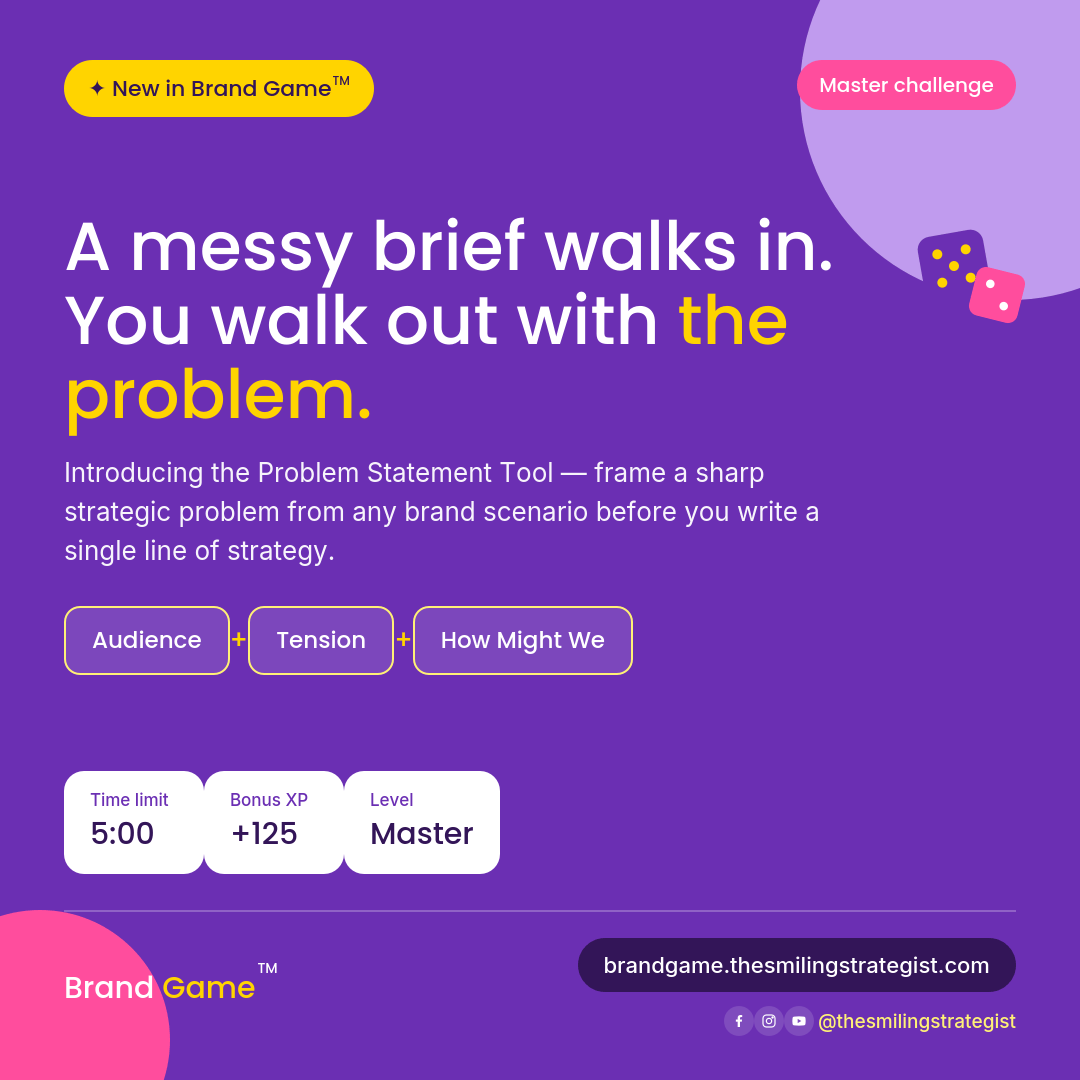
Introducing the Problem Statement Tool

To help strategists build this instinct – and make it genuinely fun to practice – we built the Problem Statement Tool, now live as a Master-level Timed Challenge inside Brand Game.

The challenge: frame a sharp strategic problem from a messy brand scenario in 5 minutes, using the same three-part structure senior strategists use instinctively:

  • Audience – who, specifically, are we solving for?
  • Tension – what friction, belief, or barrier is standing between them and the brand?
  • How Might We – the reframed question that turns a problem into a brief a team can actually run with

It’s timed, it’s scored, and it earns bonus XP – because the fastest way to build strategic instinct is to practice it under real conditions, not just read about it.

FAQ

What is a problem statement in brand strategy? A problem statement is a concise definition of the strategic challenge a brand needs to solve, typically built from the target audience, the tension or barrier they face, and a reframed “How Might We” question.

Why is the problem statement important before writing brand strategy? Because strategy built on the wrong problem solves the wrong thing, no matter how strong the execution is. A well-framed problem statement keeps the entire strategy – positioning, messaging, creative – anchored to what actually matters.

What is the Audience + Tension + How Might We framework? It’s a structured way to frame strategic problems: identify who you’re solving for (Audience), the friction or barrier they face (Tension), and reframe it as an actionable question (How Might We) that opens up solutions rather than narrowing to one.

How can I practice writing problem statements? The Problem Statement Tool inside Brand Game turns this into a timed, scored challenge – a fast, low-stakes way to build the instinct for framing a sharp problem before you build a strategy around it.

Try it yourself

Think you can frame the problem before the clock runs out?

👉 Explore Brand Game

Brand Game Joins IMAA Group Deals: An Exclusive Offer for Australia’s Independent Agencies

Brand strategy has a reputation problem. Say the words “strategy training” in a room full of marketers and watch the eyes glaze over, somewhere between “quarterly compliance module” and “mandatory fire drill” on the excitement scale.

We built Brand Game to change that. And today, we’re thrilled to announce that Brand Game is officially available on IMAA Group Deals, an exclusive offer just for IMAA members across Australia.

What is Brand Game?

Brand Game is the world’s first gamified learning and training platform for brand strategy. Strategy has never been gamified like this before – instead of lectures and lengthy frameworks gathering dust in a drive folder, Brand Game turns strategic thinking into play. Teams learn by doing, competing, and (occasionally) gloating. It’s professional development your team will actually look forward to.

Why IMAA?

The Independent Media Agencies of Australia (IMAA) champions the indie agency community and independent agencies are exactly who Brand Game was made for. Sharp, hungry teams who want to punch above their weight on strategy without enterprise-sized training budgets.

We owe an enormous thank you to Sam Buchanan and the entire IMAA team for making this partnership possible. Sam’s kindness, generosity, and unwavering support for the independent agency community made this an absolute joy from day one.

What’s the deal?

This is an exclusive Group Deal available only to IMAA members across Australia. If your agency is an IMAA member, head to the IMAA Group Deals portal to access your offer – and then head straight to the leaderboard.

Ready to play?

We can’t wait for IMAA members to try Brand Game, sharpen their strategic instincts, and have some genuine fun doing it. Because the best brand strategists aren’t born – they’re trained. Preferably while having a laugh.

👉 Explore Brand Game: https://brandgame.thesmilingstrategist.com

Game on, Australia. 🎮

Why Good Work Matters

Have you ever thought why good matters, why good work matters?

What does it mean for something to be good? 

It feels like such a simple word, almost too simple for the weight it carries. And yet today, in a world governed by metrics, monetisation, and measurable returns, good has become a rare currency. Elusive. Quiet. Often overshadowed by what is louder, faster, and more immediately rewarding.

In The Difficulty of Being Good by Gurcharan Das, goodness is not presented as something obvious or easily attained. It is complex, layered, and often inconvenient. To be good is not to be perfect. It is to wrestle with doubt, to question oneself, to act with integrity even when the outcome is uncertain. It is, in many ways, a continuous act of becoming. 

Across time and cultures, there has been a quiet insistence within us. A pull toward truth, toward fairness, toward something that feels inherently right. The wisdom embedded in the Vedas speaks of rta (a cosmic order), a truth that sustains the universe. To live in alignment with this truth is to contribute to balance, to harmony, and to goodness itself. It is not about grand gestures. It is about consistent, mindful action. About doing what is right, even when it is unseen. 

In my own journey, building a life in unfamiliar terrains and navigating both personal and professional spaces, I have often encountered moments that felt anything but good. Situations that were unfair. Systems that seemed indifferent. Times when you pause and wonder, does goodness really exist, or is it just something we tell ourselves to endure the chaos? 

But then, almost unexpectedly, it reveals itself. In a gesture. In a piece of work done with care. In a decision made with courage when no one is watching. In the quiet resilience of people who continue to choose integrity over ease. 

For all the noise, the speed, and the relentless churn of content and opinion, there is, underneath it all, a growing restlessness. A quiet but persistent yearning. People are searching for truth that feels unmanufactured, for justice that feels real, for work that does not merely impress, but resonates.
And maybe that is our moment. Not just to ask whether good exists, but to participate in its return.

And that is where good work matters. 

Because in an industry driven by visibility, performance, and constant output, it is easy to lose sight of why we create in the first place. But if we return to the idea of goodness, not as a superficial label but as a deep commitment to craft, honesty, and intent, then the work changes. 

To celebrate good work is to affirm a belief. A belief that integrity still matters. That craft still matters. That intention still matters. 

Because the only way to keep good alive is to keep making it. 

And perhaps, in choosing to make good work, consistently and consciously, we are doing more than shaping campaigns or building brands. 

We are, in our own way, helping bring the good back into the world. 

Source: Manifest Media

#thesmilingstrategist #manifest #advertising #writers #goodwork

Gamified Brand Training

When AdNews comes calling on gamified brand training… you know the game is ON.
A little chat with AdNews just turned into something bigger than expected and honestly? We’re here for it. 🙌

Here’s the thing: brand strategy has always been treated like a boardroom secret. Dense frameworks. Expensive consultants. Death-by-PowerPoint.
We said: what if learning and training in strategy felt like levelling up? 🚀

Brand Game™ is the world’s first gamified learning platform built specifically for brand and creative strategy, a category we didn’t just enter, we created. There’s nothing else like it in the market. Zero. Nada.

And in a world where brands are fighting harder than ever to cut through the noise, knowing how to build a powerful brand strategy isn’t a nice-to-have anymore, it’s the ultimate competitive advantage.

Whether you’re a marketer, a founder, a creative, or a strategist, Brand Game™ was built for you.

👉 Play your first move here: https://brandgame.thesmilingstrategist.com

Big love to the AdNews team for the openness, curiosity, and support. This is just the beginning. 🎯

Read the full article here: https://www.adnews.com.au/news/a-strategy-gym-might-be-the-answer-to-upskilling-the-industry

#TheSmilingStrategist #BrandGame #BrandStrategy #GamifiedLearning #MarketingInnovation #CreativeStrategy #BrandBuilding #MarketingEducation #EdTech #TheSmilingStrategist #AdNews #LearnAndPlay #StrategistLife #MarketingCommunity #CategoryCreator #BrandMarketing